
Last time, I left you with thirty muddy monks.
If you missed it, here's the story. Thirty monks set out to spend the rains retreat with the Buddha, and they didn't make it in time. The retreat began while they were still a few days' walk away, so they kept their word and stayed put. For three months they lived close enough to almost see him.
When the rains ended, they didn't wait for the roads to dry. They walked the rest of the way through mud and downpour, and they arrived soaked, their robes heavy and filthy.
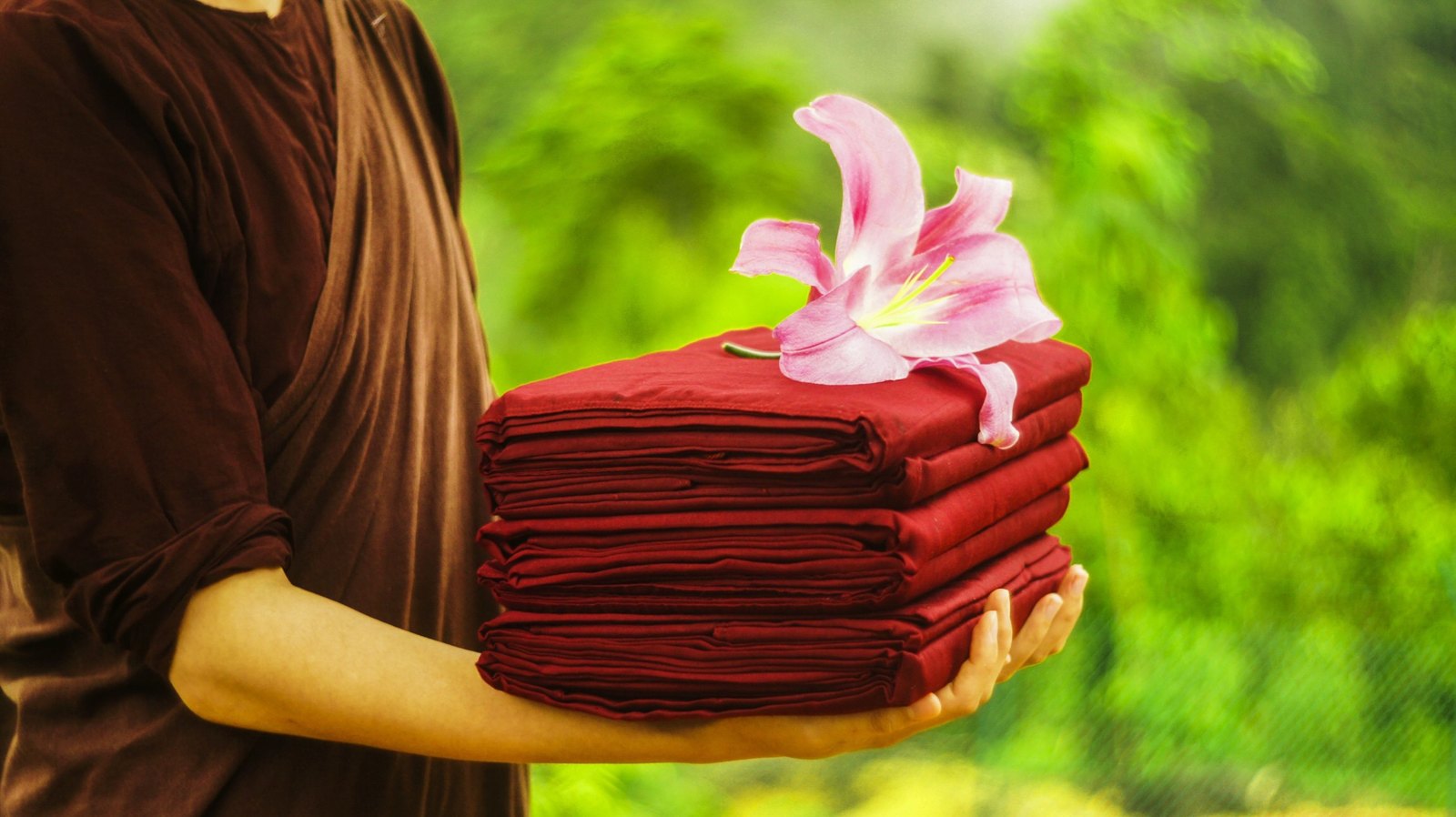
What happened next is why, every year in the month after the rains, Buddhist communities all over the world gather to offer new robes to their monks. It's called Kathina, and it's one of the biggest giving days of the Buddhist year.
It also comes with some strange rules. The more I looked into them, the more I realized the rules are the point.
What the Buddha did with the mud
When the thirty monks arrived, the Buddha didn't scold them for showing up in that state. He asked how their retreat had gone. They told him: they'd kept the rule, and they'd been miserable being so close and not getting to see him. Then they told him about the road.
His answer was practical. He allowed that, after the rains, monks who had completed the retreat could receive cloth and make new robes together. (Vinaya, Mahāvagga VII)
The word kathina comes from the wooden frame monks stretched cloth across to sew it. It can also mean firm, or solid. I like holding both meanings at once: something that holds the cloth steady while it's made into something useful.
Rule one: you don't get to choose who receives it
This is the rule that surprised me most.
When lay people offer Kathina cloth, they don't hand it to their favorite monk. They offer it to the Sangha, the community of monks as a whole. Then the monks decide together, through a formal act, which one of them receives it. Traditionally it goes to the monk whose robes are the most worn out, and who knows how to make the new one.
So the giver doesn't pick. You give, and you let go of where it lands. In a world where so much giving comes with a name on it, and a photo, and a choice about who deserves it, that's a quietly radical idea.
Rule two: it has to be finished in one day
Once the cloth is given, the robe has to be cut, sewn, dyed, and finished before the next dawn.
One monk can't do that alone. So everyone pitches in: monks, novices, and lay people, cutting and stitching and boiling dye through the night. In some places, communities go further and spin raw cotton into thread, weave it, and sew the robe all in one day and night.
The deadline is what makes it a community. Nobody finishes it by themselves.
Rule three: the robe is made of pieces on purpose
Have you ever looked closely at a monk's robe? It isn't one solid piece of cloth. It's a patchwork of panels, laid out in rows.
That design goes back to a day the Buddha looked out over the rice fields of Magadha, all those neat paddies divided by little raised paths, and asked his attendant Ānanda if he could make a robe that looked like that. Ānanda did. The cloth was cut into pieces and sewn back together in the pattern of the fields.
There was a practical reason too. Cut-up cloth is worth almost nothing to a thief. (Vinaya, Mahāvagga VIII) A robe made of pieces is a robe nobody wants to steal. Something made humble on purpose, in the shape of the fields that feed everyone.
Why people wait years to give it
Kathina can only be offered in the one month after the rains. Each temple can receive it only once a year, and only if at least five monks completed the retreat there.
Growing up, I saw what that rarity does to people. Sponsoring a Kathina wasn't something anyone took lightly. For a lot of families it was close to a once-in-a-lifetime chance, and some waited on a temple's list for years before their turn came. When it finally did, the days leading up to the ceremony turned the whole house into a workshop. People cooked for days and invited relatives and friends to come share in the merit. In Lao communities, they built money trees: frames hung with folded bills, carried in as part of the offering.
Years later, when I served on a temple board, I helped arrange one myself. The way I grew up doing it, the offering goes well beyond the robe. You offer a bed and everything that goes with it, the bedding and the everyday things a monk needs to live, all set up together as a single gift. People who didn't grow up with it are often surprised: a Kathina can look less like a gift of cloth and more like a whole room being moved in.
It's a gift with a window. Miss it, and you wait for next year.
So what does this mean for us?
The rains retreat was about keeping a commitment through discomfort. Kathina is what happens on the other side: a community showing up for the people who kept their word.
And I think it asks us a few honest questions.
Who in your life kept their word this year, even when it cost them? A friend who got sober. A sibling who stayed through a hard season at home. A coworker who carried something heavy without complaining. They walked through the mud to get here. Did anyone meet them with something clean and dry?
When you give, do you need to choose exactly where it lands, and get seen doing it? Or could you give the way Kathina gives: to the whole, and let it go where it's needed most?
And when someone you love has a deadline they can't meet alone, are you one of the people up all night with a needle and thread?
Made of pieces
Here's what stays with me about that robe.
It was never one perfect piece of cloth. It was scraps, cut on purpose so they'd be worth nothing on their own, then sewn back together by a whole community racing the dawn, in the shape of the fields that feed everyone.
That's how anyone gets through the cold. Not in one piece. In pieces, held together by people who showed up.
So this Kathina season, find someone who came through the rains muddy, and bring them something clean and dry.